"But I own that I cannot see as plainly as others do, and I should wish to do, evidence of design and beneficence on all sides of us. There seems to me too much misery in the world. I cannot persuade myself that a beneficent and omnipotent God would have designedly created that a cat should play with mice."
-- Charles Darwin, Letter to Asa Gray
Showing posts with label future of journalism. Show all posts
Showing posts with label future of journalism. Show all posts
This from deep in the piece, his fifth reason for hope.
The new online operations remind us how important is the resource of obsessive, endless, gritty enthusiasm. Yes, somehow there has to be a way for these individuals to pay their bills – ultimately. They don’t have to dine on expense accounts. What they have to do is pursue work that gets their adrenalin going and makes them feel that they are doing something that matters. If they can make money doing this, that’s good for them and that’s good for society and that’s good for democracy. But many worthwhile pursuits endure without a so-called business model. Artists, musicians, dramatists have been doing it for centuries. And so have some journalists, those who set up their alternative weeklies in the sixties, those who worked for political magazines or started vegetarian newsletters or pieced together a living as free-lance foreign correspondents. They lived on a combination of passion and lowered expectations for comfort. With just about everyone I have talked to at the new start-ups, whether twenty-somethings at one of their first jobs or 50-somethings who had been let go or had taken buy-outs. One top editor from a major daily newspaper, now working at Pro Publica, told me she felt she had died and gone to heaven, that she was doing more of the work that had led her to journalism in the first place than at any other time in her career.
Talking yesterday with the indestructible G., who is typical of our successful USF journalism grads in the sense that he was a self-starter, finding internships, cultivating would-be employers, working like a dog at successive internships and jobs, in short, taking the rough map sketched on the back of the napkin and venturing out into the unknown, brave and bold.
Or, to put it another way, we are not a big journalism program. We don't manufacture journalists, though I think we are pretty good at "enabling" those who already know what they want to be.
And, in fact, enabling is a pretty good word, suggesting as it does that a career in journalism is a kind of addiction. Which it is. And now a technological and financial climate change has reduced the supply of stuff, as it were. Where do you get your job, i.e., your work-as -fix, as news organizations crumble?
So I'm talking to G.
Turns out he and an acquaintance were talking about the plight of the young journalist today, about how innovative economic models for paying reporters to go get the news may yet emerge, but that, at best, for some time to come journalists both young and old will continue getting dumped into a trough of non- or under-employment.
That's best case. Let us hope this bleak abyss is merely the perigee of what will prove to be a sharp "V" of collapse and recovery, and that after a brief season of famine, new jobs will emerge, and once more this rag-tag army of vagrant journalists will have work-with-a-paycheck, doing what they love to do.
But meantime -- even if the future is brighter than it looks -- times will be tough. As I said: That's best case.
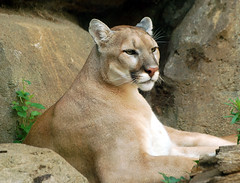
Well, G's acquaintance suggested that perhaps it's time for you (G, smiling and being smiled at) to find your own foundation support, as it were, your own "non-profit" sponsor. It's time you found yourself your own personal Cougar, she said, to collaborate in this great enterprise of news gathering during these hard times so that you can continue to do the reporting you love and the nation needs and thus help preserve the democracy, as journalism is supposed to do.
This giver of advice being herself a Cougar, G. noted, for he has the reporter's sharp focus on relevant detail.
To which I can only say: Every art must have its patrons. Same as it ever was.
I would ‘tell them a story.’ Maybe you don’t have a long list of disconnected ‘brags’ to bombard schools with, but think about some personal experience, or life narrative, that illustrates your passion, your curiosity, your commitment to some of the things a journalist should be committed to.The point is not that you have done a whole bunch of disconnected things, like some over-scheduled high school student trying to brag his/her way into an Ivy League college. The point is that at a moment when a career in journalism takes a real leap of faith because no one knows who will pay you to do journalism , you still are going to embrace it, go for it, follow your heart *and* your mind because society needs journalists – that’s what heart and mind tell you. You see the sacrifices that this moment of crisis in journalism may require. And you are still going to go for it.
And that's remarkable. I think I’ve just made myself cry.
Today is the 144th Anniversary of the San Francisco Chronicle, which I celebrated by taking part in a panel discussion about whether or not its print edition will see a 145th birthday. It was a lunchtime event at the University Club on Nob Hill across the cable car tracks from the Fairmont Hotel.
The club is old-fashioned elegant with dark wood-paneled walls, a horseshoe bar that gave me a bit of buzz just to contemplate and a couple or three elderly members dozing peacefully in leather chairs. You can't smoke in the bar any more, but you can smoke on the terrace, and a faint odor from the cigars drifts in, a smell that touches the memory an instant after it touches the olfactory nerve.
The panel was in the big dining room on the floor below, a room with a wall of windows and good light. I'd say the crowd approached 50, mostly folk of my vintage who love print but love it in that special San Francisco way, recalling Herb Caen and the Chronicle in the Sixties, Seventies and even Eighties (when it was my playpen) when the newspaper was a little silly, a little naughty and very well written.
It was also a good enough newspaper for the news of the world if you weren't the most godawful snob.
As I was saying, the audience was print-loving, and I tried to prod them by saying we were talking about the wrong thing, that it didn't matter when the print edition died since most experts say print is dead so get over it. What mattered -- the question as it should have been phrased -- was how soon the Chronicle's Internet presence will figure out how to attract enough ad dollars to pay the salaries of some generous fraction of the existing newsroom.
"Four newspapers hit my lawn every morning," I said. But the perpetuation of print is a diversion. It's the perpetuation of journalism that matters because real journalism is platform agnostic.
And so on. My fellow panelists Carl Nolte -- USF grad and living treasure -- and Ken Garcia, the Examiner columnist, talked about how the journalists on the inside feel about their future. Nolte and Garcia seemed optimistic enough. Garcia said the Examiner's free-tabloid model is working; it's making money. And that is one possible model for the survival of print, a free "hyper local" tab during the week, a subscription broadsheet on Sunday.
In retrospect, I think perhaps I talked too much. I had done some research. I had note cards. As a reporter I was a good listener. But now I have the lecturer's habit of filling any large space with the sound of my own voice. One thing I mentioned but did not elaborate on is a point raised in that recent story in the Atlantic predicting -- or at least raising the possibility -- that the New York Times could go under during the next few months. One of the provocations the writer presented, which I have also been thinking about, is what portion of contemporary newspaper content really matters? The absence of which stories would do damage to the republic?
I recall the writer in the Atlantic said only two percent of what is currently in the Times matters to the health of the body politic, the original and still the most powerful argument for a free press. That number strikes me as a little low, and I think he may undervalue routine local news that incrementally helps us know what is going on and can guide or prompt our community involvement. But I agree with his basic idea. It's the investigative journalism and a few think pieces that matter -- if anything in a newspaper matters.
But isn't it the froth that, since the advent of the penny press 175 years ago, has brought the great mass of newspaper readership into the garish and vulgar tent? Didn't the money the froth made raise all boats, including those of the investigative reporters, whose stories are so often NOT those to which first we turn?
And now the Internet is bright shining froth as far as the eye can Google. Perhaps, on that first morning there is no more print newspaper, and the newspaper website is thin as thin can be given the lack of a newsroom to back it up, the disappearance of certain kinds of journalism will focus the attention of those to whom it matters, and they will figure out some mechanism to pay for it.
Massive tax breaks? Direct government support, even? Non-profit foundations subsidizing the public good? Throwback Men of Wealth and Conscience who are willing to buy a "content generator" and "lose a million dollars this year and a million dollars next year," happy in the knowledge that they won't be out of money for 60 years? Simple subscription models that serious readers will finally accept in spite of our visceral notion that "information wants to be free" -- meaning *for* free? Virtuous amateurs who take vows of poverty and service and give their lives to journalism as fair and balanced as it is passionate and full of advocacy?
I have no idea. But today I kept talking anyway. I used to be a journalist. Now I'm a college professor!
Now, a look at the old religion of newspaper salvation.
Felt's death raised the inevitable question: Could the kind of reporting that Woodward and Carl Bernstein pulled off be done today, more than three decades later, in the age of the Internet?
For many reasons, I believe it could. But it would probably play out quite differently.
There are still whistle-blowers like Felt in government today -- probably many more than there were back then. They are encouraged by various public employees' organizations and protected by whistle-blowers' legislation enacted after Watergate. And they have many more investigative reporters to talk to -- not only at newspapers, despite deep and worrying cuts in newsroom staffs, but also many other media outlets, including investigative Web sites and blogs.
So Downie is optimistic and suggests that blogs -- and god help us cable tv -- would surface such a story more quickly. However, he adds:
In an age when the media have been turned upside-down by the biggest shifts in audiences and economic models since the advent of television, my two biggest questions about whether we could still pursue a story like Watergate center on resources and verification. Many Americans, including opinion leaders in Washington and elsewhere, simply didn't or wouldn't believe The Washington Post's reporting about Watergate during its early months -- not until we were joined by the New York Times, Newsweek, CBS News, Judge John J. Sirica, the Senate Watergate committee and the special Watergate prosecutor.
In today's cacophonous media world, in which news, rumor, opinion and infotainment from every kind of source are jumbled together and often presented indiscriminately, how would such an improbable-sounding story ever get verified?
As newsrooms rapidly shrink, will they still have the resources, steadily amassed by newspapers since Watergate, for investigative reporting that takes months and even years of sustained work.
So in spite of his top-of-the-essay optimism, he comes back to the question that consumes me. Where's the economic model for future investigative journalism?
Perhaps, crowdsourcing solves the problem. Perhaps, the whole investigative process can be compressed when many hands work at it. Perhaps, some news sites, some of them blogs, will gain renown for aggregating and interpreting all this new information, and will gain authority based not on their original reporting but on their judgment.
 Image via Wikipedia
![Reblog this post [with Zemanta]](http://img.zemanta.com/reblog_e.png?x-id=edb3c7d1-ab00-460b-86e2-89a264547ea8)


 Reblog this post [with Zemanta]">
 Reblog this post [with Zemanta]">
![Reblog this post [with Zemanta]](http://img.zemanta.com/reblog_e.png?x-id=0d7443a0-e1b3-4db6-a17d-719630b7f0eb)


 Posts
Posts


