Showing posts with label die newspaper die. Show all posts

Saturday, July 24, 2010

Let Me Die Obscure and Forgotten

Reading the newspaper: Brookgreen Gardens in P...Image via Wikipedia

Journalists do have their loyalties, to their former colleagues and thus, by extension, to themselves. A day or two ago the Chron ran an obit for Bob Bartlett, whom I remember from my own newspaper days. He quit in 1985 to practice law in Montana.

But the wine remembers. Or maybe I mean the drinkers remember.

For, indeed, I do not recall socializing with Bob in the newsroom but do recall having drinks with him at the old M&M, my own dear newspaper bar my association with which plugs me into something greater than myself, that is, the damp lies of clever journeymen content providers from back in the day in which the providers actually went out there and waded in the content.

He was kind of a blowhard, I recall, and *that's okay*. Modesty is ingratiating, but it's not very interesting. (And I will play the fool for you if you play the fool for me.)

Anyway, he died and some old guys in the Chron newsroom followed the accepted practice: When a former colleague dies, you give him an obit -- which is more or less an act of giving the profession, and thus yourself, a valentine because, as you read the obit currently on the table, you imagine your own obit when the time comes and how noble the great enterprise was.

I put in 11 years at the Chron and have stayed local as a "journalism educator" -- note the sly,self-effacing irony of the quotations marks -- so if I die tomorrow I will get my obit. (Here's looking at you, Nanette.)

But as I wrote to old Chron colleague JC, in his retirement fortress in Arkansas, it is my goal (as it should be his) not to have such an obit, not by declining the honor, but by outliving the very newspaper in which it would appear. (Sad: We will be dust as will the horse we rode in on.)

If we but only endure, it would seem the Chron will be a web-only enterprise, compiled by algorithm or outsourced to India. A tree will fall in the forest, except it will be the last tree in the forest.

And thus we will have the last laugh with no one to hear it.
Enhanced by Zemanta

Monday, February 15, 2010

The Long Slow Slow Long Slowlonglongslow Death of American Journalism

First cover of The Atlantic Monthly magazine. ...Image via Wikipedia

This from Oboglo.

"America has in fact transformed journalism from what it once was, the periodical expression of the thought of the time, the opportune record of the questions and answers of contemporary life, into an agency for collecting, condensing and assimilating the trivialities of the entire human existence, [...] the frantic haste with which we bolt everything we take, seconded by the eager wish of the journalist not to be a day behind his competitor, abolishes deliberation from judgment and sound digestion from our mental constitutions. We have no time to go below surfaces, and as a general thing no disposition."

Journalist W.J. Stillman, writing in The Atlantic Monthly about the negative influence of the telegraph, 1891.

Reblog this post [with Zemanta]

Friday, February 12, 2010

King of Newspaper Sociologists Big Mike Schudson Fills the Air with Hope

Statue of a newspaper vendor at the Texas Pres...Image via Wikipedia

USC Annenberg | Prepared remarks from Michael Schudson

This from deep in the piece, his fifth reason for hope.

The new online operations remind us how important is the resource of obsessive, endless, gritty enthusiasm. Yes, somehow there has to be a way for these individuals to pay their bills – ultimately. They don’t have to dine on expense accounts. What they have to do is pursue work that gets their adrenalin going and makes them feel that they are doing something that matters. If they can make money doing this, that’s good for them and that’s good for society and that’s good for democracy. But many worthwhile pursuits endure without a so-called business model. Artists, musicians, dramatists have been doing it for centuries. And so have some journalists, those who set up their alternative weeklies in the sixties, those who worked for political magazines or started vegetarian newsletters or pieced together a living as free-lance foreign correspondents. They lived on a combination of passion and lowered expectations for comfort. With just about everyone I have talked to at the new start-ups, whether twenty-somethings at one of their first jobs or 50-somethings who had been let go or had taken buy-outs. One top editor from a major daily newspaper, now working at Pro Publica, told me she felt she had died and gone to heaven, that she was doing more of the work that had led her to journalism in the first place than at any other time in her career.


Reblog this post [with Zemanta]

Saturday, September 12, 2009

Brother Pabst Pointed to This: Media Chaos = Darn Good Fun (for Those Pointing the Finger)

How does this affect teaching journalism. I'm not going to come up with the solution; I just hope I recognize the solution when someone else comes up with it.

Sunday, August 16, 2009

Bold Recommendations for Newspaper Survival Webwise (The Boldest in Boldface)

From the conclusion of Bill Wyman's provocative dissection of newspapers in their death throes.

If I were running a chain of papers, (Wyman says) here’s what I’d do:

1) Go hyper local; devote all resources, from reporting to front-page space, to local news. No one cares what the Pittsburgh Post-Dispatch has to say about Iraq.

2) Redesign the websites to present users with a single coherent stream of news stories and blog entries. Create simple filters to allow them to tailor the site to their preferences.

3) Tell the union you won’t be touching salaries, but that all work rules are being suspended, including seniority rights. Tell all reporters that they’re expected to post news if word of it reaches them in what used to be thought of as “after hours.”

4) Get out of the mindset of “nice” coverage. Tell the reporters to find the “talker” stories in town—development battles, corrupt pols, anything with a consumer bent. Monitor web traffic to find out what people are interested in. If a particular issue jumps, flood the zone. Make each paper the center of every local debate, no matter how trivial, and make finding and creating those debates the operation’s prime job.

5) Create chain-wide coverage of all areas where it can be done. It’s sad, but it means laying off a lot more film critics and dozens of other duplicated positions. For such positions, do this. Hire two people to cover the beat for the chain. Make them into sparring partners, arguing about each new TV show, movie, CD, traveling Broadway show, concert tour etc. Get out of the business of being promotional. Give your readers sharply argued opinions, something fun to read they can’t get anywhere else.

6) Create local listings second to none. Create them from the users’ point of view. Don't use abbreviations. Overwhelm users with insider information that only locals know; where to park, where to sit, when to go, etc. Get rid of all the site navigation levels no one cares about. Put the information people want front and center.

7) Devote as much manpower as possible to creating must-read local news blogs. Tell the bloggers to work the phones and IMs, finding out about every personnel change, every office move, any tidbit. Support and cite local bloggers in the same areas. Yell at staff members if they are consistently being scooped by (unpaid) competitors.

8) Create and maintain a wiki designed ultimately to function as an encyclopedia for the town, from neighborhoods and politicians to every retail establishment. Let it become the ultimate guide to the area. Like Wikipedia, it will inevitably contain information that is controversial. Cover the controversies with alacrity.

9) Serve the community. Don't publish crap. Tell folks stuff they might not want to hear. Grow a pair.


Reblog this post [with Zemanta]

Thursday, July 30, 2009

Those Optimistic Reports That Newspaper Cost-Cutting is Boosting Earnings are UP?

Front page of the New York Times on Armistice ...Image via Wikipedia

Don't believe the future is bright, says Alan Mutter at Newsosaur.

As Ken Doctor noted in this excellent analysis at his Content Bridges blog, perhaps 828,000 stories per year are not being produced by American’s down-sized newspaper industry.

Newspaper readers, who by definition are among the most thoughtful members of society, are perceptive enough to know they are paying more today for newspapers that deliver far less news and advertising than ever before. They are doing so, to the extent they are doing so, in the hopes they can help the industry survive.

But their patience will not be infinite. If newspapers can’t find a way to do better by their readers, they are in danger of slashing themselves to oblivion.
Reblog this post [with Zemanta]

Sunday, July 26, 2009

The Nigerian Newspaper Scam

LAGOS, NIGERIA.

ATTENTION: PUBLISHER SAN FRANCISCO CHRONICLE

DEAR SIR,

CONFIDENTIAL BUSINESS PROPOSAL

HAVING CONSULTED WITH MY BOB WOODWARD AND CARL BERNSTEIN AND BASED ON THE INFORMATION GATHERED FROM THE NIGERIAN CHAMBERS OF COMMERCE AND INDUSTRY THROUGH THE GOOGLE EARTH, I HAVE THE PRIVILEGE TO REQUEST FOR YOUR ASSISTANCE TO TRANSFER THE SUM OF $47,500,000.00 (FORTY SEVEN MILLION, FIVE HUNDRED THOUSAND UNITED STATES DOLLARS) WORTH OF CLASSIFIED ADVERTISING INTO YOUR NEWSPAPER. THE ABOVE SUM RESULTED FROM AN OVER-INVOICED CONTRACT, EXECUTED COMMISSIONED AND PAID FOR ABOUT TWO YEARS (2) AGO BY A FOREIGN PERSON SELLING A USED CAMPING STOVE, A FUTON IN THE ORIGINAL PACKAGINGS AND 47,500,000 (FORTY SEVEN MILLION, FIVE HUNDRED THOUSAND) GRATEFUL DEAD T-SHIRTS, IN THE XXL. THIS ACTION WAS, HOWEVER, INTENTIONAL AND SINCE THEN THE CLASSIFIED ADS HAVE BEEN IN A SUSPENSE ACCOUNT AT THE CENTRAL BANK OF NIGERIA APEX BANK.

WE ARE NOW READY TO TRANSFER THE CLASSIFIED ADVERTISING OVERSEAS AND THAT IS WHERE YOU COME IN. IT IS IMPORTANT TO INFORM YOU THAT BECAUSE OF THE WALL BETWEEN AD SALES AND EDITORIAL, WE ARE FORBIDDEN TO MOVE THE CLASSIFIED ADS INTO OUR NEWSPAPER; (WE HAVE CHECKED THE GRATEFUL DEAD T-SHIRTS ARE STILL AVAILABLE. BUT NOT THE CAMPING STOVE OR THE FUTON IN ORIGINAL PACKAGINGS.) THAT IS WHY WE REQUIRE YOUR ASSISTANCE. THE TOTAL SUM WILL BE SHARED AS FOLLOWS: 70% CLASSIFIED ADS FOR SAN FRANCICO CHRONICLE, 25% FOR LOU DOBBS SUBSCRIPTION NEWSLETTER TO KEEP THIS QUIET, 5 % FOR LONELY GIRL LAGOS ON YOUTUBE BECAUSE SHE MAKES US SO SAD. ALSO, NEED TO KEEP OUT SIX OR SEVEN T-SHIRTS TO SPREAD AROUND TO THE RIGHT PEOPLE.

THE TRANSFER IS RISK FREE ON BOTH SIDES. I AM AN AD SALESMAN WITH THE NIGERIAN DAILY BEAST. IF YOU FIND THIS PROPOSAL ACCEPTABLE, WE SHALL REQUIRE THE FOLLOWING DOCUMENTS:

(A) YOUR BANKER'S NAME, TELEPHONE, ACCOUNT AND FAX NUMBERS. ALSO, SAME INFORMATION FOR YOUR PARENTS IF YOU HAVE HAD TO MOVE BACK IN WITH THEM IN MID CAREER WHILE YOU RETRAIN WHICH IS NOBODY’S FAULT NOT YOURS NOT THEIRS. THEY WANTED YOU TO GO INTO LAW SCHOOL BUT YOU SHOULD NOT TELL THEM TO SHUT UP THEY ARE YOUR PARENTS.

(B) YOUR PRIVATE TELEPHONE AND FAX NUMBERS. IF YOU HAVE I-PHONE WE WOULD LIKE TO BORROW THAT. WE HEAR THAT NEW BEST WAY NOW OF GETTING THE BREAKING NEWS.

(C) YOUR BUYOUT DATE. IF IT’S TOO NEAR IN FUTURE, WE DON’T WANT TO HAVE TO START THIS PROCESS ALL OVER WITH SOMEONE ELSE. YOU WOULD NOT BELIEVE HOW OFTEN THAT HAPPENS.

PLEASE REPLY URGENTLY. THERE HAS BEEN A MAN FROM CRAIGSLIST COMING AROUND.

BEST REGARDS.

AARON EWADAFE

AD SALES MANAGER

DAILY BEAST

Reblog this post [with Zemanta]

Tuesday, July 21, 2009

Charging for Online Content

A puzzle undone, which forms a cubeImage via Wikipedia

I find the notion of a sliding pay scale strangely exciting.

Journalism Online's offering is more flexible and compelling than it may have sounded at first. Far from a one-size-fits-all approach, the company allows news outlets to customize their pay schemes with 15 different variables. Publishers will be able to do everything from selling monthly subscriptions to charging micropayments for individual articles with a sliding pricing scale based on the timeliness of the news. "What we're giving them is a set of dials they can constantly turn," says Brill. "In no case is is simply charging or not charging. It's not simply a pay wall goes up around everything."
Reblog this post [with Zemanta]

Wednesday, July 01, 2009

Isn't It Pretty to Think So? Nah. It's *Beautiful*

SEATTLE - MARCH 16:  Copies of the last ever p...Image by Getty Images via Daylife

From Jack Shafer in Slate:

Let me say it another way: The barriers of entry into the journalism business have been battered down, making it easier than ever to enter the profession. That will read as small consolation to the journalists who have had their publications shot out from under them—the Rocky Mountain News, the Seattle Post-Intelligencer, the Ann Arbor News (come July 23), and magazines too numerous to tally. But please notice that I'm not saying there has never been a more lucrative or prestigious time to become a journalist. The cash and status associated with the profession are fairly recent. Until the early 1970s or thereabouts, the average journalist made an average salary (if that), and his societal standing was modest.

If the downside of the battered-down barriers to entry is less pay and lower status, the potential upside is that a flood of new entrants into the field could portend a journalistic renaissance. No, I'm not saying that every junior blogger and pint-size videographer will immediately stand as tall as Barton Gellman and Errol Morris and that the Washington Post and NBC News should be flushed. But journalism has generally benefited by increases in the number of competitors, the entry of new and once-marginalized players, and the creation of new approaches to cracking stories. Just because the journalism business is going to hell and it may no longer make economic sense to maintain mega-news bureaus at the center of war zones doesn't mean that journalism isn't thriving.


Reblog this post [with Zemanta]

Monday, June 01, 2009

Good Advice to Journalism Grads. (Good Ain't Always Pretty)


Barbara Ehrenreich talks sense to Berkeley journalism grads.

How do you think it feels to be an autoworker right now? And I've spent time with plenty of laidoff paper mill workers, construction workers and miners. They've got skills; they've got experience. They just don't have jobs.

So let me be the first to say this to you: Welcome to the American working class.

Monday, May 11, 2009

Kos Obscenities in the Mother's Milk of Newspapers and 'Sense of Community'

According to the San Francisco ChronicleImage by Thomas Hawk via Flickr

I don't agree with him completely, since I think for some people -- and not only the rich and powerful -- newspapers provided a sense of local identity, if it was only Herb Caen nattering on about cool grey fog and local drink menus. Let us not deride the great middle class and its wish to know, to belong, to understand. To some degree, newspapers focus our interest on things local and do create some commonalities.

To which I imagine Kos might say bullcrap, because he does say:

That "sense of community" thing? It never existed. Newspapers have always served the wealthiest members of their communities -- the people that will buy the stuff that advertisers were peddling. So ethnic communities have always been underserved. In San Francisco, Asians make up over a third of the population -- the largest single ethnic group in the city -- yet the San Francisco Chronicle doesn't have a single Asian columnist in its stable. Do you think the Asian community sees the Chronicle as a member of its community? Of course not. And given they were traditionally a relatively poor immigrant community, the Chron had little interest in engaging that part of the city.

All around the country, you see the major metro dailies completely ignore entire chunks of their cities. Why do you think the New York Times writes story after story after story talking about those poor unemployed Wall Street types no longer able to buy caviar or $800 doll houses for their daughters?

The reason alternate media has taken off was because the traditional media didn't deliver a product people wanted. If people felt a "sense of community" from their newspaper, perhaps they may have stuck with the product. But they don't, hence it's easy to toss it aside for the countless alternatives at the public's disposal.


Reblog this post [with Zemanta]

Friday, May 01, 2009

The Chronicle Tour: Yes, There Were Neutron Bomb Jokes

SAN FRANCISCO - SEPTEMBER 20:  (FILE PHOTO) Fr...Image by Getty Images via Daylife

I thought the Chronicle tour yesterday was a success, if only because the students must have thought, "With all these empty cubicles, there must be room for me."

Actually, the nightmare vision of holes in the fabric of the newsroom was a little misleading. We showed up at 11 a.m., and things are busier 3p-11p, when the business of putting the paper together gets serious. But a lot of familiar faces were absent -- Rubenstein, Rubin, Carl Hall, Bonnie Lemon, Tom Meyer, plus all those who came after I left in '91 who have since moved on.

The highlight of the tour was an impromptu rant from living legend Carl Nolte (USF, class of Cambrian Era) who more or less told the kids that, lacking a business model, journalism was something they needed to put in their rear view mirrors. Our guide, the wonderful Nanette Asimov, listened for a bit and then gently disagreed, suggesting quality journalism would find its way -- e-paper, anyone? -- and that people would want it, that some "monetized" delivery method would emerge. She told the kids not to give up, not just yet, not if journalism was something for which they had Passion.

The ever cheerful Kevin Fagan wandered over and shared his impatience with the self-styled "journalists" who cluttered the weird press conference he'd covered the day before at which a woman announced her dad was the Zodiac killer. But covering the various loonies was so much fun, he manifested, and God knows he's done enough good grim work to justify his pleasure in the occasional loon-fest.

His contribution to the discussion was more one of mood: Who knows the future but so much fun in the job today.

I don't know what the kids thought. They'll tell me on Tuesday. If they show up.

Wednesday, April 29, 2009

Tomorrow the Reporting Class Tours the Chronicle

We've been doing this for nearly 20 years, since I came over to the university for all sorts of reasons, one of which was that I had spent six years (three of them full time) getting the darn Ph.D. back in the day, and it chapped me that it had all been a waste.

Other than self development, of course. I really did enjoy reading all those books.

In one way, taking the kids to the Chron was a little like returning to Duke, having the sense that here was something that had existed before me, that did more good than harm, that would go on doing more-good-than-harm long after I had passed.

Oh yes, the hallowed halls -- actually an open-office newsroom -- of the Chronicle. I liked to imagine a student of mine somewhere down the line working at the Chron and finding some relic of my days there, and thinking of the old man suddenly (for the first time in years really) and in some vague way being grateful -- for me, for the paper, for whatever I said that did no permanent harm.

This is not going to happen, or if it happens, it will be in a contracted space and radically altered platform laboring under a different vision and little patience for what we used to do when the Chron was a great mosaic of the good, the bad and the foolish-by-design.

The Chron was a pretty good newspaper, you know, with lots of goofy where everyone else went for stuffy and, in my opinion, all the better for the playfulness.

Then, it got serious and now it's getting steamrolled, which has nothing to do with all the rethinking that went into calming it down, which change was well underway before I left.

I used to miss the Old Chronicle, but now it looks as if I'm going to be missing the Chronicle Period. A man should not outlive his nostalgia. I think that's what I'm saying.

Postscript: Hey, look! An interactive map of newspaper woe.

Saturday, April 04, 2009

The Never-ending Conversation: Oh What Will Come of the Newspapers?

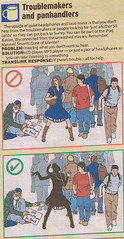
The Vancouver Province's solution to troublema...Image by sillygwailo via Flickr

I pulled this out of Romanesko and sent it to Ricardo and Big Pat:


"There are only two ways to stop the newspaper death spiral"


Calbuzz
Phil Trounstine and Jerry Roberts write:
* Newspapers have to concentrate all of their force and fire power on their own communities, making themselves indispensable to local residents.
* Or, a business like Google or Yahoo can begin to pay reporters in communities to produce content -- to cover city councils and school boards, write about local development and utilities, local sports and arts, etc.
Posted at 10:15 AM Apr. 2, 2009


Ricardo responded:

Thanks for the link. I agree with the general drift of local focus and internet deals as promising tunnel end of light.

Somehow, against the odds, the swell of letters to the Chron editor on this topic, silly often though not always, and particularly those commenting on facets of a non-profit reorg approach (with well-compensated newspaper pros) gives me an odd hope.

I'd ignore those letters if they didn't fit so closely with reporting on Gavin Newsome and rich guys talking out loud about this same thing. So, put me down in the unlikely optimist column, regarding the Chron only, with little hope for big city papers elsewhere.


And then Big Pat said:

The problem I see with this is that “all force and power on their own communities” will likely shake out to, “all force and power to wealthy communities”. Who will cover the local ghetto, West Fuck, Shasta county, or Weed, California? Not that they do a good job today, but I don’t see a new model reaching the same high level of ignorance as what we have now. Small town papers, with exceptions, are in the pocket of their advertisers. They loathe to run local investigative pieces. They don’t have the expertise and they don’t want to pay for the expertise, they want to talk about the county fair.


And so then *I* said.

Yah, Pat is right – newspapers are owned by the pillars of the community and all flows from that. Indeed, the heretical question is what fraction of what is in a newspaper appeals to what fraction of those voters and activists who move events one way or another achieving some substantive change of how things change, politically or otherwise. We say newspapers matter, as I naturally would since my self-image and my reason for being is intimately connected with the notion that they do/did matter. (And I was a feature writer for god’s sake.)


Maybe what comes after will accomplish whatever good things newspapers have accomplished – but with less preening, less self-important huffing and puffing? It’s not a rhetorical question mark.


Reblog this post [with Zemanta]

Sunday, March 15, 2009

MoreMore More on Dying Newspapers

Here are comment made by John -- no last name; the mystery, the mystery -- over at Alan Mutter's Reflections of a Newsosauer. Is he right? Is emphasis on local news some sort of American oddity? Would word-of-mouth, plus "volunteer" blog-based news, actually work for cities like Oakland and San Francisco?

The US newspaper market has always bemused me in it size and structure. There is no other news market in the world with such a strong reliance on locally driven content. This creates a byzantine cost structure that ultimately harms the industry. That mid-sized cities cannot support more than one paper is barely a surprise. The question should be whether it can support a paper at all.

A shakeout that results in a ~4-6 national papers (perhaps with the odd local insert) will bequeath a stronger industry where the parent company can capture more synergies across the group. Not only that but the funds will remain in place for high quality investiagtive reporting that is essential for a well functioning democracy.

Reblog this post [with Zemanta]

Saturday, March 14, 2009

Oboglo Shot a Newspaper in Reno Just to Watch it Die. For its Own Good

The amount of workforce dedicated to agricultu...Image via Wikipedia

From Kwame Oboglo:

on Boing Boing today. There's more there, but it's too techy to maintain my absorption.


When reality is labeled unthinkable, it creates a kind of sickness in an industry. Leadership becomes faith-based, while employees who have the temerity to suggest that what seems to be happening is in fact happening are herded into Innovation Departments, where they can be ignored en masse. This shunting aside of the realists in favor of the fabulists has different effects on different industries at different times. One of the effects on the newspapers is that many of its most passionate defenders are unable, even now, to plan for a world in which the industry they knew is visibly going away.

And here's the money-shot:

When someone demands to be told how we can replace newspapers, they are really demanding to be told that we are not living through a revolution. They are demanding to be told that old systems won’t break before new systems are in place. They are demanding to be told that ancient social bargains aren’t in peril, that core institutions will be spared, that new methods of spreading information will improve previous practice rather than upending it. They are demanding to be lied to


Reblog this post [with Zemanta]

Wednesday, March 11, 2009

Oh See the Poor Newspaper Stocks Lying There in the Gutter

Brother Pat Daugherty pulled this out of the San Diego Reader and shared.
From this week's Reader no less
Here's how much the market has knocked down newspaper stocks in the last 52 weeks. I picked 10 representative newspaper stocks; half of them are significantly diversified into other media. The list includes the cream from a quality standpoint: Washington Post, NY Times, etc. During the last 52 weeks, the Standard & Poor's 500 has gone down 46.55%. Seven of the ten newspaper stocks have gone down more than 90%. Here they are, with stock performance over the last year: Gannett (the largest chain, whose bonds were downgraded to junk this week) down 92.04%; E.W. Scripps down 99.28%; McClatchy down 95.59%; Lee down 96.9%; Media General down 90.05%; GateHouse Media down 98.61%; AH Belo down 92.92%; News Corp. (Murdoch's company, including Dow Jones) down 63.8%; New York Times down 76.72%, and Washington Post down 52.82%. It could be overkill -- but what will be the societal effects if it isn't?

Reblog this post [with Zemanta]